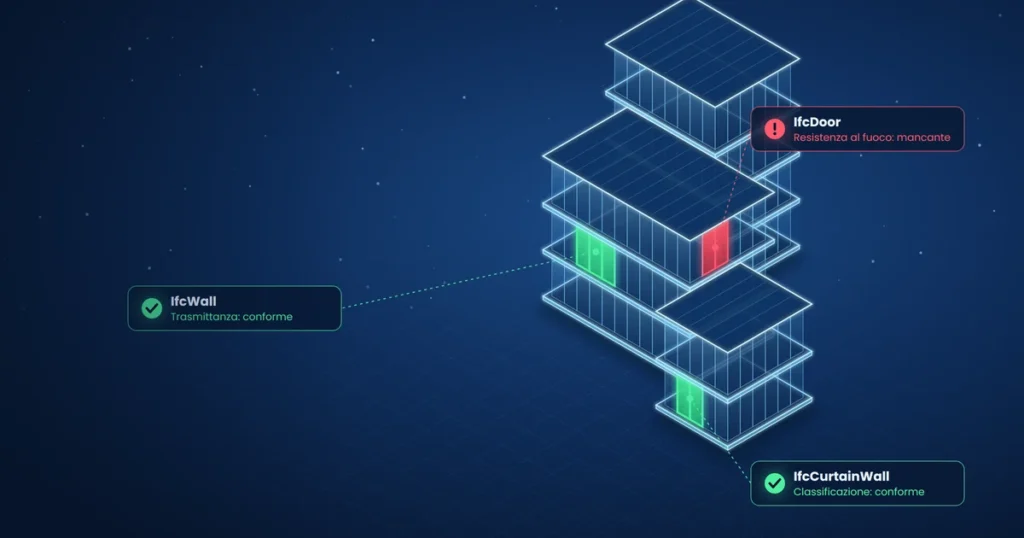
Starting from 1 January 2025, the obligation to adopt the methods and tools of management of information in digital for many public works above certain thresholds makes the model BIM is increasingly central to the interior of the building process.
Today, the model only assumes a value comparable to that of a technical report or a graphic. When the documentation is delivered to you, the Public Administration controls and verifies the models on the basis of the requirements of the contract documents Only. In this context, a non-conformity of information can have an important impact on the overall rating of a race.

Because the validation of the models, the IFC is increasingly important
In the field Engineering & Construction is produced a huge amount of information, but a very large part of these data remains unused.
The problem is not only concerned with the amount of information required, but above all the ability to test them, to read and use them effectively.
Models BIM can in fact be multi-disciplinary, use IFC classes different to describe similar elements, include custom properties, Property Sets, Quantity, Set, and the specific classifications. Even if the format IFC is a standard and extremely powerful, the complexity of the models makes it necessary validation of the continuous information.
With the evolution of the standard IFC 4.3 that integrates the growing use of BIM in infrastructure sector, the theme of the verification of the models in IFC, therefore, becomes more and more strategic.
When we talk about validation in the field of BIM, we generally refer to three main areas: validation, reporting, validation, and geometric verification legislation.
Validation information: verify the quality and consistency of the data
and the validation of The information pertains to the control of the presence, correctness and consistency of the information contained in the IFC model with respect to the requirements of the contract documents Only.
This means checking, for example, that an item is correctly classified as IfcWall instead of a generic IfcBuildingElementProxy or property, materials, attributes, and quantities are compiled in the correct way.
The goal is to answer some fundamental questions:
- the model is consistent from the point of view of information?
- the required data are present?
- the information is reliable compared to its intended purpose?
In a process BIM mature, these controls are essential to avoid errors, inconsistencies, and activities to review later.
Validation of the geometric and clash detection
A second area concerns the validation of the geometric model.
Here the activities commonly associated with clash detection, hard clash, that soft clash. In the first case, we speak about interference, physical elements; in the second, instead, you control clearances, volumes of the respect and space needed for the installation, maintenance, and accessibility.
Anyone who works in design knows how important it is to consider manufacturing tolerances, installation, technical spaces and access maintenance. A model can be formally correct from the point of view of geometric, but still not really be buildable or manageable.
For this reason, the geometry inspection is not limited to the detection of collisions, but also evaluates the functional coherence of the spaces and elements designed.
Verification rules: the building information model as an operational tool
, The most evolved of the validation concerns the regulatory compliance.
In this case, the model BIM becomes a tool accessible to automatically verify design requirements and regulatory constraints.
Some examples include:
- verification of the minimum distances from the streets to escape
- the control of the minimum requirements for the compartments fire
- analysis of accessibility and the presence of architectural barriers, the
- verification of the minimum technical requirements as the thermal transmittance of the insulating or the respect of copriferri minimum.
The value of BIM does not reside only in the three-dimensional representation, but in the possibility of using structured information to actively support the design and constructability of the work.
CheckIFC: the system validation IFC developed by EDBIM
To meet these needs, EDBIM has developed CheckIFC, a system dedicated to the analysis and the validation of the models, IFC.
The software uses artificial intelligence to generate micro-application specialized in the management of the queries necessary for the verification of the model BIM. This approach allows you to gradually extend the capabilities of control, adapting the checks to the information requirements, geometric, and regulatory required by the project.
One of the most important aspects is the independence from the authoring software original: through the open format of the IFC, is the one who produces the model, is the one who receives it can check in a concrete way, the quality of the information.
From formal control and intelligent management of information
and the validation of The IFC is not only a step technical or bureaucratic.
Instead, it is a strategic tool to transform the building information model in an operational support to the design, testing, and management of the entire process of building and infrastructure.
In an industry that is increasingly complex and oriented to the management of data, check the quality of the information means to reduce errors, improve coordination and increase the overall reliability of the project.