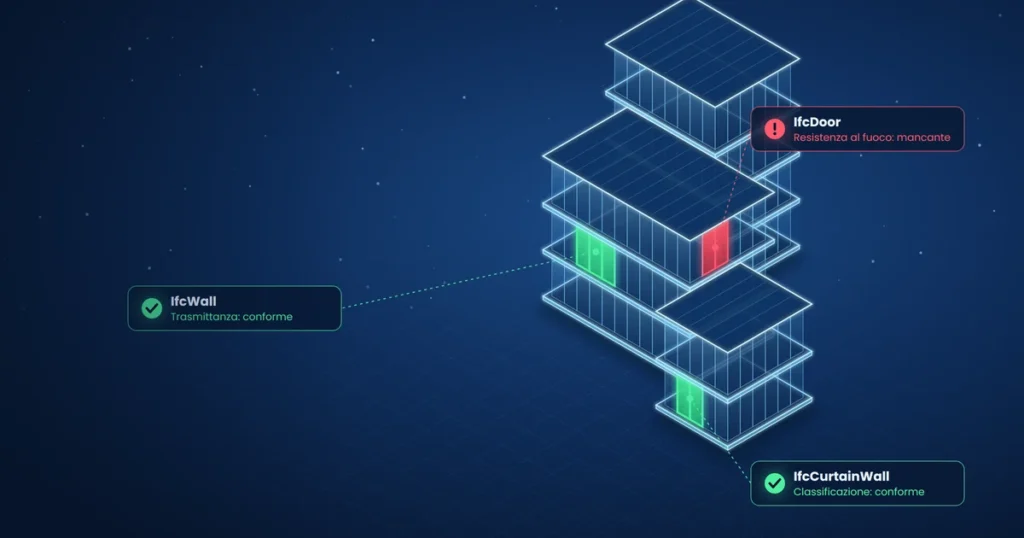
Those who actually work with the models in IFC knows the difficulty is not “open” a file, but you understand if that what it contains is really reliable.
In real-world projects, an IFC file is never a neutral object. It is the result of an export from an authoring tool, often influenced by the conventions of BEP (BIM Execution Plan), custom properties, hierarchies, simplified or incomplete documentation. The result? The questions are in operation and the ones that you need for bills, checks, and decisions require time, experience, and a sequence of controls that few tools are able to manage in a structured way.
AskIFC: a tool for querying really the IFC model
AskIFC was born to solve this problem. It is a tool designed for the advanced query models, IFC, capable of transforming natural language queries in a structured reading and verifiable content only. It is not a simple chatbot which “describes the model”. His approach is different: to provide a reliable answer, one must first reconstruct the conditions of truth within the model. Each response is derived from a precise path that crosses the entities, relationships, properties and context, until you get to the final validation. It is not just the result, but the process that leads to obtain it.
The real problem: the IFC is not a list, but a graph,
One of the most common mistakes is to think of the IFC as a list of objects. In reality, an IFC model is a relational system. A wall, for example, can exist as a IfcWallStandardCase, but really becomes useful only when it is correctly inserted in the spatial structure of the project, which is connected to its own type, with properties consistent and associated materials and reliable quantities.
When even only one of these relations is missing, it results in seemingly correct, but operationally useless. This is the case, for example, in the calculation of the surface: if the data are not consistent or standardized, the result can be numerically accurate, but technically wrong.
A structured method to query a model IFC
To avoid answers fragile, AskIFC adopts an approach based on macro-areas of verification. Instead of returning a direct result, the system breaks down every request in a sequence of checks. This means analyzing the structure of the model, to verify the correctness of the classification of objects, check the presence and the quality of the property and evaluate the continuity of the relationships between the elements. Add this to the checks on the geometry, on placement, on the consistency of the amount and the correct use of the materials. The result is a complete reading of the model that allows to pass from a simple response to a response really reliable.

Specific cases: what it means to interrogate a good IFC
how Many rooms are there and what are the areas?
A question which seems simple, it actually requires several steps. It is necessary to properly identify the IfcSpace, to verify the containment within the model and read the data of the area from the correct source. If the model has any duplication, placeholder, or spaces that are not assigned, the result can be misleading. For this, an effective system must be able to signal any faults.
How many elements belong to multiple plans?
In this case, it is not enough to read the storey assigned. It is necessary to compare the containment logic with the geometry and distinguish between elements legitimately multi-level and real modeling errors.
The doors have panic bars?
The information is not always at the same point in the model. Can be associated to the instance, type, or custom properties. To get a reliable answer is therefore necessary to search for the data on multiple levels, normalize the conventions, and return a result that is verifiable, highlighting any exceptions.
You can get a BoQ reliable model?
This question requires a comprehensive evaluation. It is not enough to extract the data: you need to check the completeness of the amount, the consistency of the units and the presence of a generic object or proxy. A correct answer, in this case, it also includes the limitations of the model.
Why question correctly IFC is critical
In the flow BIM real, the models are used to concrete decisions: bills, checks, coordination and management of the work. For this, an interrogation system effective, it must be able to not only provide useful answers, but also to demonstrate the reliability. AskIFC introduces this discipline: read the model as a complex system, break down the analysis checks that are verifiable and handle exceptions in real. It is an approach that allows you to use the artificial intelligence in the BIM in a concrete way, transforming it from a generic support to operational tool really useful.